HWID ban and spoofer: what it is and how a ban bypass works
If you play with cheats, sooner or later a frightening abbreviation comes up — the HWID ban. Unlike an ordinary account block, this one does not end with buying a new profile. In this article we go through honestly what HWID is, why this kind of ban hurts the most, which folk methods of bypassing a ban do not actually work, and what sort of beast a spoofer (also known as an HWID spoofer) is.
What HWID is — the fingerprint of your hardware
HWID (Hardware ID) is a unique fingerprint of your computer, assembled from the identifiers of its components. The anti-cheat reads serial numbers and parameters of various parts: the motherboard, drives (SSD/HDD), network card, RAM, graphics card and sometimes even BIOS and monitor parameters. All of this forms a set of markers by which the system recognises your specific machine — not an account, an IP or a nickname.
The logic is simple: an account is easy to create again, but you cannot assemble a new computer in five minutes. That is why modern anti-cheats stopped relying on the login alone long ago and increasingly tie the punishment to the hardware.
Why an HWID ban is worse than an ordinary block
An ordinary ban blocks the account. Unpleasant, but solvable: create a new profile and you are back in the game. An HWID ban blocks the device itself. That means any account that enters the game from this computer falls under the ban. You can create ten new profiles — if the hardware fingerprint is the same, you will be turned away at the door or banned again.
Hence all the pain: what suffers is not a virtual nickname but the physical machine you paid real money for. And until the hardware markers are changed, the road into the game is closed.
Busting the myths: what does NOT save you from an HWID ban
A lot of folk recipes circulate around bypassing a ban, and almost all of them are useless against a hardware block. Let us go through the main misconceptions:
- A new account. Does not help at all. The ban is on the device, not the profile — a new account catches exactly the same block.
- A VPN and changing your IP. A VPN hides your network address, but the anti-cheat looks at the fingerprint of your components, not the IP. Hardware does not change through a VPN.
- Changing the MAC address. It used to work, but now the MAC is only one of dozens of markers. You changed the network card address, while the serials of the drive, board and memory stayed the same — you will be recognised anyway.
- Reinstalling Windows. The most persistent myth. A clean system does not touch hardware serial numbers — they are baked into the components themselves. After a reinstall the HWID stays the same and the ban does not go anywhere.
The conclusion is simple: until the hardware identifiers are changed, no action at the account, network or OS level solves the problem.
What a spoofer is and how it works
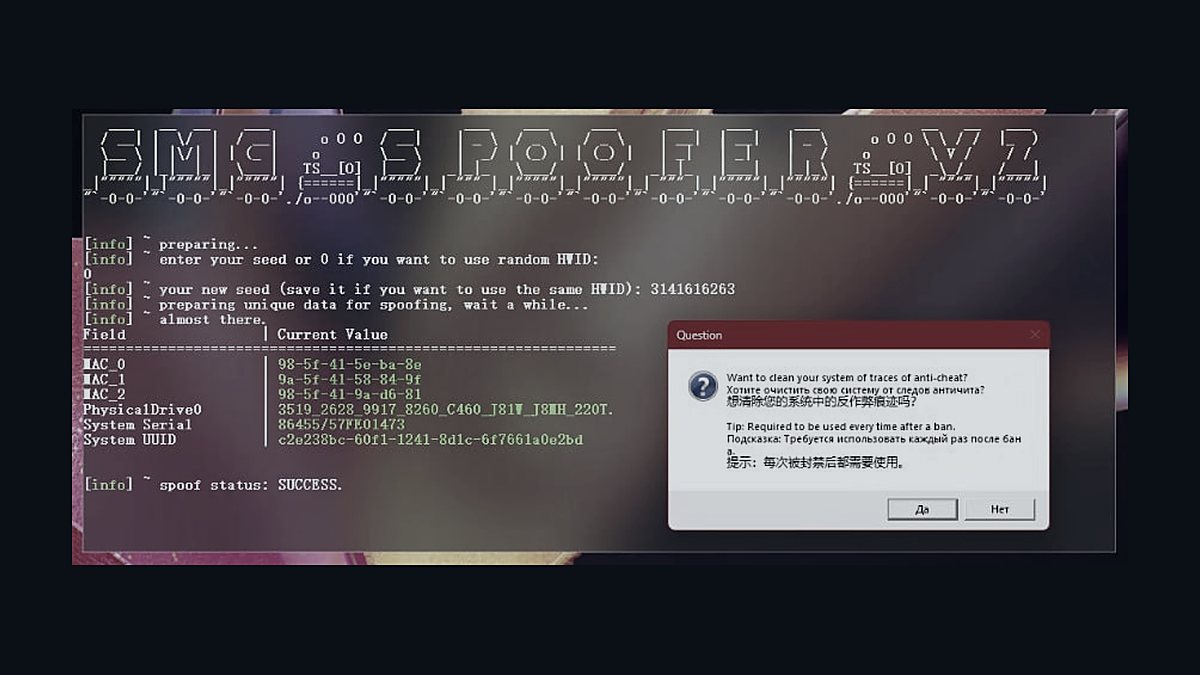
A spoofer (HWID spoofer) is a program that replaces or clears those very hardware markers by which the anti-cheat identifies a banned device. Roughly speaking, a spoofer makes the system report different serial numbers and identifiers, so that to the game your computer looks new and unfamiliar.
A spoofer usually works like this: it cleans the traces of the previous detection and the old markers, and then substitutes the readable identifiers of your components — the drive, the motherboard, the network card and other parts. As a result the HWID fingerprint changes and the anti-cheat no longer links the current machine to the previously banned device. That is exactly why a spoofer is the main working tool for bypassing a hardware ban, when a reinstall and a VPN are powerless.
Honestly about the risks: a spoofer lowers the risk but gives no guarantees
Here it is important to speak plainly. A spoofer lowers the risk of being detected again and helps you get back into the game after an HWID ban, but it does not give a hundred per cent guarantee. Anti-cheats are updated constantly, adding new ways of reading hardware and new methods of detecting spoofers themselves. No developer in their right mind will promise you eternal invulnerability or a refund for a ban — that is pure marketing.
What genuinely improves your chances: quality private software that is maintained and updated, careful use, and an understanding that absolute protection does not exist. Private solutions are by definition less visible than public ones, which have long been in anti-cheat databases. You can find a current and maintained spoofer in the ResellerCheats catalogue — it states which games and versions it works with.
In short: an HWID ban hits the device, and it is only cured at the hardware level, by changing the fingerprint. A spoofer does that job, but treat it as a risk-reduction tool, not as a magic button that means you will never be banned.
Ready to pick private software with a current undetected status?
Go to catalogue